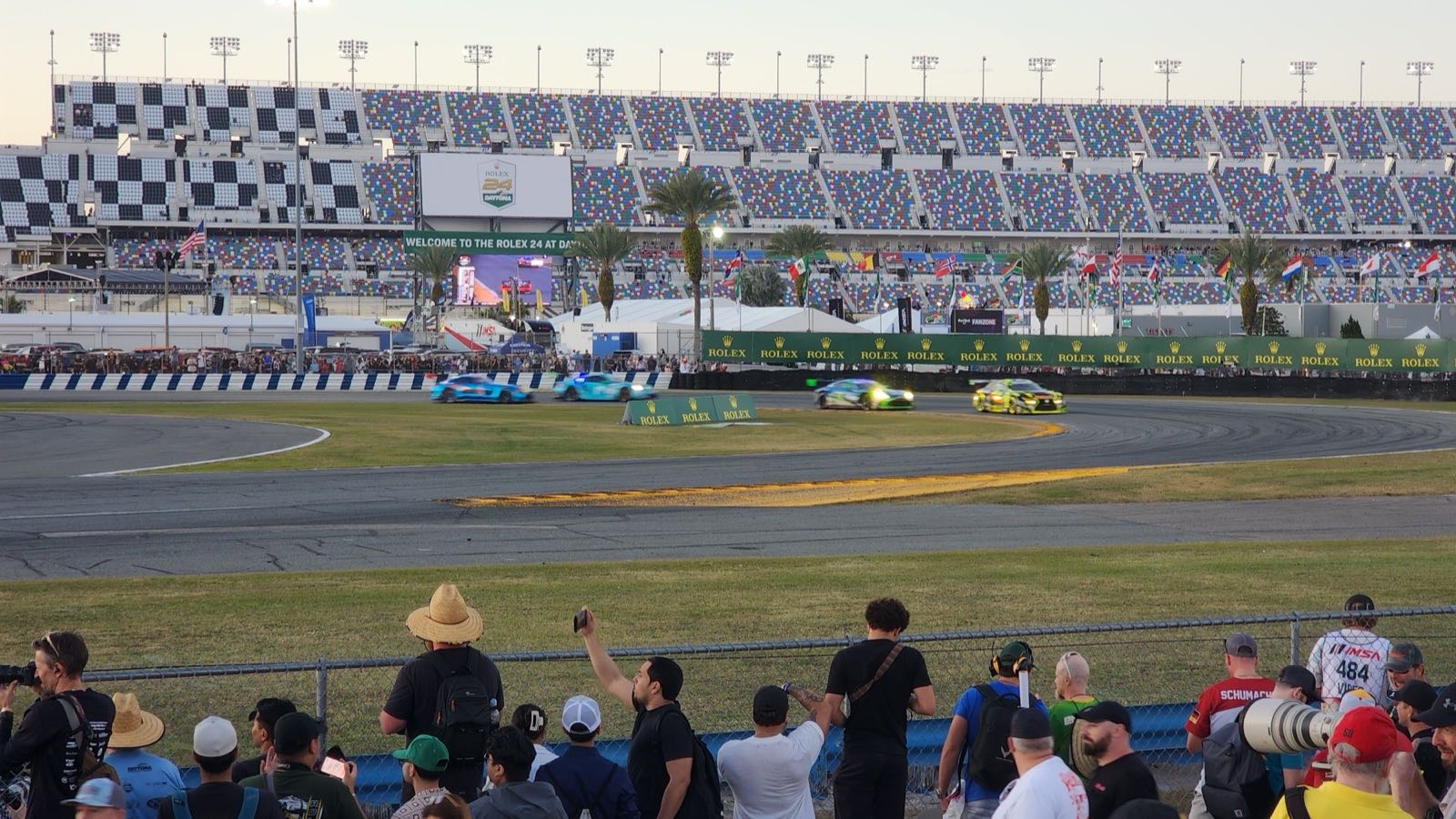
Where should you sit to watch the Rolex 24 at Daytona?
The Rolex 24 runs on Daytona’s 3.56-mile road course, not just the oval, so the best place to watch is not one seat. Take the frontstretch grandstand for the start and the pit stops, then roam the infield to the International Horseshoe, the Bus Stop chicane, and the superstretch. The infield is open to everyone.
Here is the thing most people get wrong before they arrive. They picture the Daytona 500. A pack of stock cars, the whole field circling one big oval, and a seat high in the frontstretch grandstand that shows you the entire lap. That is the right answer for the 500. It is the wrong answer for the Rolex 24, and if you buy a Rolex 24 seat thinking it works like the 500, you will spend the weekend a long way from the best of the racing.
I am on the ground for this one. Let me walk you through where to actually be.
Why the road course changes the whole question
The Daytona 500 runs on the 2.5-mile tri-oval, the high banking you know from television. The Rolex 24 uses that same banking, but it adds the infield road circuit, and the two together make a 3.56-mile road course. The cars come across the start-finish line on the banking, drop down into the infield, work through a set of slow and technical corners, then climb back onto the banking and run the superstretch back around to the line.
That one change rewrites the seating question. On the oval, the story is the pack and you want to see all of it at once, so you sit high. On a road course, the story is spread out across corners that each show you something different: hard braking here, a slow corner where a driver can make a pass there, a flat-out sweep somewhere else. No single seat shows you all of it. That is not a flaw. It is the whole point of a road course, and it is why the right move at the Rolex 24 is to move.
The corners worth knowing
You do not need to memorize the track map. You do need to know a handful of spots, because each one gives you a different kind of racing.
The tri-oval and start-finish. This is where the frontstretch grandstand looks out, and it is the seat to have for the big set-piece moments: the green flag with the whole field pouring down toward Turn 1, the pit stops on pit road below you, and the run to the flag on Sunday afternoon. Pit road is where a 24-hour race is quietly won, so a frontstretch seat over the pits is never a wasted seat.
The International Horseshoe. A tight, slow corner in the infield where the cars almost stop, get hard on the brakes, and drivers go looking for a way past. Slow corners are where you see car control and overtaking up close, and the Horseshoe is one of the best in the country for it. It is also the corner the sun sets through on Saturday evening, which is the shot you have seen a hundred times and will not believe you are standing in.
The Bus Stop chicane. Some people call it the Le Mans chicane. It sits out on the back of the circuit where the cars arrive at real speed and have to check up hard for a quick left-right flick. Heavy braking zones are prime viewing: this is where mistakes happen and where one class catches another.
The infield esses and the superstretch. The infield section rewards a driver who can place the car, and the superstretch, the high-banked run back toward the line, is where they are flat out and closing on slower traffic. Watching a GTP prototype run down a GT car through here, four classes sharing the same asphalt, is the thing endurance racing does that nothing else does.
Grandstand, infield, or roaming
Here is how I think about the three ways to watch, because most people want a mix of all three.
The grandstand is your home base. The frontstretch seats give you the start, the pit stops, the finish, and a big-screen video board for everything happening out on the far side of the circuit. Buy the reserved seat for the moments that draw a crowd, and for a place to sit down when your feet are done.
The infield is where the road-course racing actually lives, and at Daytona the infield is open to everyone. You can walk right up to the fencing at the International Horseshoe, the Bus Stop, and the infield corners and watch the cars work from a few feet away. This is the part fans who only know the 500 do not expect. You are not stuck in your seat. The best corners are yours to go find.
Roaming is the move that separates a good Rolex 24 from a great one. Watch the start from the grandstand, then spend an hour trackside at the Horseshoe, then walk to the Bus Stop, then back to the pits. Each stop is a different race. The venue is built for it, and the people who wander end up seeing far more than the people who plant themselves in one seat for 24 hours.
If you want someone doing the reading for you while you roam, telling you which corner to be at and what is about to happen there, that is the whole idea behind the guided Rolex 24 host experience.
A quick note on food
Do not plan on the grandstands feeding you the way the Daytona 500 does. The Rolex 24 draws a smaller crowd than the 500, so not every concession stand in the stands will be open, and the ones that are can be spread out. What the event does have is vendors brought in just for the 24, and food trucks parked in the infield. That is one more reason the infield is where you want to be: walk the trucks, grab something, and eat trackside at a corner instead of hiking back to a stand that is closed. Bring a little cash and do not count on a full-service grandstand.
Day versus night: the seat changes after dark
This race runs around the clock, and where you want to be changes with the hours.
In daylight, height helps. The grandstand and the video board give you the shape of the race and the pit sequences. Through the afternoon and into the evening, the frontstretch and the Horseshoe are the places to be, right through sunset and the fireworks around ten.
After dark, get down close. The overnight is when the infield fences come into their own. The cars run under the speedway’s floodlights, the crowd thins out, and standing at the fence at the Horseshoe or the Bus Stop at one in the morning, with the cars flying past a few feet away and the sound coming at you out of the dark, is the Rolex 24 that people who have done it never stop talking about. You can hear the gearbox and the throttle in a way daylight never lets you. If you only ever watch from a grandstand seat, you miss it.
For the full picture of the overnight and how to plan your sleep around it, through the night at the Rolex 24 is the one to read, and how to plan a Rolex 24 trip walks through the whole weekend.
The access nobody expects
The single most important thing to understand about watching the Rolex 24 is that the access is wide open compared to most big races. The infield is open to everyone. The garages are open, no credentials and no walls, which almost never happens at a race this size. Pit road is viewable from public areas. A general admission ticket lets you walk the venue at any hour of the 24.
What that means for your seat: do not overthink the reserved-seat decision the way you would at the 500. Get a frontstretch seat for a base and the big moments, then let the infield and the garages carry the rest of your weekend. The room to roam is the best thing this event gives you, and it is included for everyone.
How Racing Passport handles the seats
The reserved seating, the hotel three blocks from the gate, and the garage and pit access all get planned around your group in a conversation before anything is booked. That is what our Rolex 24 at Daytona packages handle, and the 2027 running is the current trip. Tell us how you like to watch, sit-and-settle or up-and-roaming, first-timer or been-before, and the seat gets matched to it. Prices are quote-led, so you get a number built for your group rather than a shelf price.
Frequently asked questions
Where are the best seats for the Rolex 24 at Daytona?
There is no single best seat, because the Rolex 24 runs on a road course, not just the oval. The frontstretch grandstand is best for the start, the pit stops, and the finish. For the racing itself, the infield corners are better: the International Horseshoe and the Bus Stop chicane put you feet from the cars. The strongest plan is a grandstand base plus roaming the open infield.
Is the Rolex 24 seating the same as the Daytona 500?
No. The Daytona 500 runs on the 2.5-mile oval, where you sit high in the frontstretch grandstand to see the whole pack. The Rolex 24 uses a 3.56-mile road course that adds the infield circuit, so the racing is spread across corners no single seat can see. A Daytona 500 seat is the wrong plan for the Rolex 24.
Can you watch the Rolex 24 from the infield?
Yes. At Daytona the infield is open to everyone, and it is where the best road-course viewing is. You can walk right up to the fencing at the International Horseshoe, the Bus Stop chicane, and the infield corners. The garages are open with no credentials, and pit road is viewable from public areas. A general admission ticket lets you roam the venue all 24 hours.
Where should you watch the Rolex 24 at night?
Get down to the infield fences after dark. The overnight is when the frontstretch grandstand matters least and the trackside corners matter most. Standing at the International Horseshoe or the Bus Stop under the floodlights, with the cars a few feet away and the crowd thinned out, is the part of the race people remember for years. Rest when you need to, then come back for the pre-dawn hours.
Do you need a reserved seat for the Rolex 24?
A reserved frontstretch seat is worth having as a home base for the start, the pit stops, and the finish, and for somewhere to sit down over a 24-hour weekend. But you are not tied to it. The open infield and garages mean much of the best viewing does not need a reserved seat at all. Racing Passport builds the seating around how your group likes to watch.
Bottom line
The Rolex 24 is a road-course race, so the answer to “where do I sit” is really “where do I go.” Get a frontstretch seat for the start, the pits, and the finish, then spend your weekend roaming the open infield to the corners where the racing actually happens, and get down to the fences after dark. Tell us how you like to watch, and the seat and the weekend get built around it.