
My grandfather put me in front of a transistor radio during a visit to Oregon. The IMS Radio Network was calling the Indianapolis 500. Stay tuned for the greatest spectacle in racing. That was the beginning.
We listened until ten or twenty laps to go, then waited until that evening to watch Jim McKay and Wide World of Sports show the replay. Foyt, Rutherford, Andretti, the Unsers, Tom Sneva. Names that reverberated through the airwaves and into memory in a way that never left.
When the chance to attend in person came in 2000, I jumped. My brother and I went together for the next ten years, no matter what. Twenty-seven years and I have never sat in the same seats twice. Tent camping in Speedway, Indiana. The Coke lot. The paddock penthouse. Each one taught me something different about what it means to be inside this race. The strategy, the tire calls, the communication between a driver and his engineer, the way a team reads a race from the pit wall. The preparation that happens in the garage and on the pit lane long before the car ever hits the track.
Then there are the traditions. I am not too proud to admit that a tear comes to my eye every year during the singing of Back Home Again in Indiana. It has happened every time. It will happen again.
That gap between attending a race and understanding it is exactly what Racing Passport exists to close.
Two businesses built on the same idea.
My wife Stacy and I are entrepreneurs. We tend to look at things differently.
When Stacy built Early and Away, her travel advisory practice, the premise was not simply booking trips. It was creating curated experiences built around the marriage of destination and literature. The place and the stories written about it, woven together into something more than either alone.
Racing Passport applies that same principle to motorsport. The convergence of storytelling, travel, and the kind of insight that comes from being inside the sport. Not just attending the premier events on the calendar, but experiencing them in a way the average fan cannot.
For the practical version of how that translates to the trips we actually plan, read What Racing Passport Actually Does.
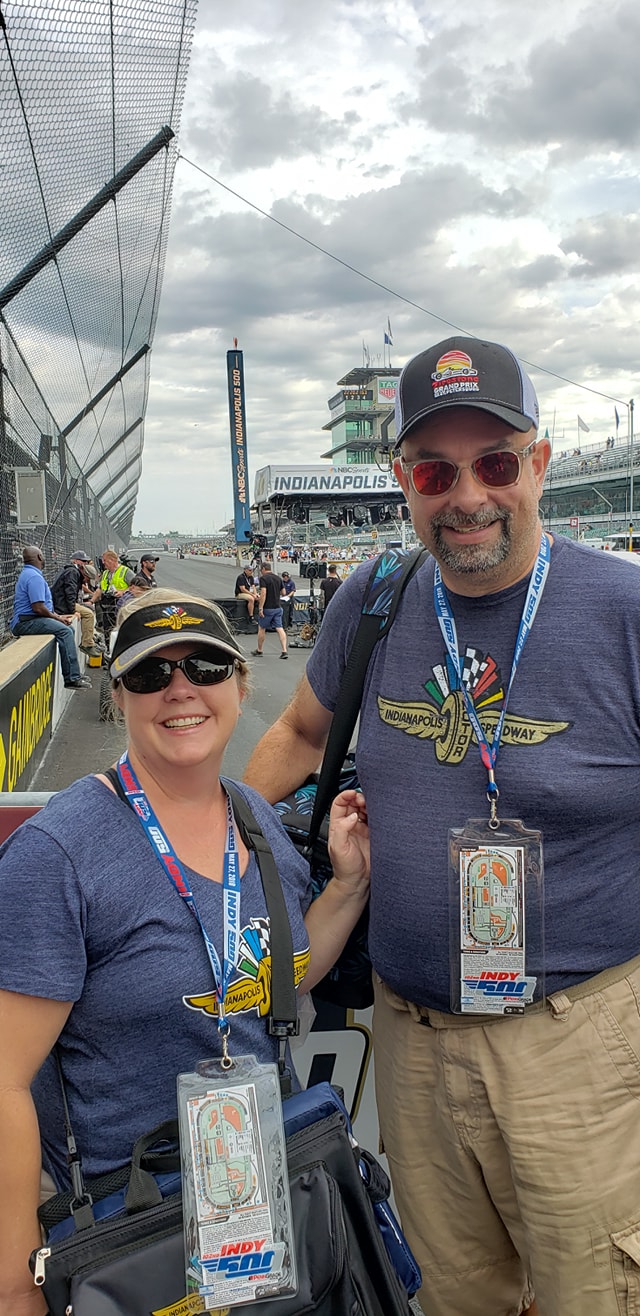
Robert and Stacy at Indianapolis Motor Speedway.
The interview series that started before Racing Passport had a name.
The story of 33 Dreams of Indy begins at Gateway Motorsports Park in St. Louis in late 2019. I had attended IndyCar races as a fan for years. Baltimore, Richmond, St. Pete, Dover with the IRL. But Gateway was my first race as a credentialed member of the media and the beginning of something I had been building toward. Podcasts, digital storytelling, and Zoom interviews feel like the obvious format now. In 2019, pursuing that kind of access and telling those stories that way was ahead of where the sport was.
I gravitated to the Road to Indy pits. USF 2000 Pro and Indy Lights. For some of those young drivers it was their first time on an oval. Growing up around stock cars in Yakima, Washington, I understood exactly what that felt like. The drivers, their teams, their parents were happy to share their stories. I was there to hear them and tell them. Those conversations were the kerosene on the small ember that became 33 Dreams.
I planned to follow the series full time in 2020. Only one problem. COVID. I was at St. Pete for the first race of the season that never happened. When racing resumed, only essential personnel were permitted in the pits. 33 Dreams was placed on the shelf.
The dream has never died. It is ignited every time I am around the drivers, the races, and the teams.
33 Dreams of Indy is named for the 33 cars that start the Indianapolis 500. It was never meant to be just an interview series. It is a storytelling project, a chance for the drivers themselves to explain the journey. The sacrifices, the work, what it actually takes to pursue the singular dream of one day being among the 33 blessed to start the greatest race in the world.
One interview that captures what the series is about was with David Malukas, recorded the week of his 18th birthday when he was still climbing the Road to Indy ladder. He has since finished second at the Indianapolis 500 twice. I was there when the dream was first forming.
See the guided 2027 Indy 500 weekend →
Some make it. Some don't. Some move on to other series. Watching them grow and develop, the breakthroughs, the setbacks, the occasional frustration, is as rewarding as following their results on a timing screen. Today's USF driver is tomorrow's Indy NXT driver. Today's Indy NXT driver is tomorrow's paddock name. The relationships that produce that kind of access are built years before anyone is paying attention.
If I found this compelling, I figured others would too. That same curiosity extends across all of motorsport, from a local short track on a Saturday night to NASCAR, IMSA, Formula 1, and IndyCar. The series change. The thing that pulls me in does not.
The sport gives back more the more you understand it.
That has been true across forty plus years inside the sport and twenty-seven years at the Indianapolis 500. The storytelling started because the stories were there and nobody was telling them the way they deserved. Drivers climbing the Road to Indy on shoestring budgets. Teams making strategy calls mid-race that nobody in the grandstands could see. The history of the sport sitting in a museum most visitors walk past without context.
The community that formed around Racing Passport is made of people who feel the same way. Not passive spectators. People who want to understand what they are watching, ask the questions that don't get asked on a broadcast, and see the sport from the inside.
The access experiences are where all of it becomes real. If you want to be in the room where the real conversations happen, that is what Racing Passport was built for.
The Passport newsletter. The 33 Dreams interview series. Race coverage and editorial that follows curiosity about the sport wherever it leads.
People who want to understand what they are watching. Who ask questions about tire management and fuel windows and why a driver says what he says after a difficult weekend. That conversation is worth having.
Motorsport at its highest level is worth experiencing from the inside. Robert Earl and the Racing Passport team take you there. The races, the paddock, the moments that never make it onto a broadcast. Knowing what to look for changes everything.
Roadtrips All-Star Sports Travel Specialist.
Racing Passport is a Roadtrips All-Star Sports Travel Specialist. Roadtrips is one of the most respected names in premium sports travel, with more than thirty years building access experiences at the world's premier events.
The All-Star designation reflects expertise and experience in the field. It means Racing Passport clients benefit from a network of vetted partners, hotel blocks, hospitality access, and relationships built over decades at the events that matter most.

Racing Passport on every platform.
Behind-the-scenes from the Indy 500, F1 weekends, NASCAR Sundays, Rolex 24 nights, and travel days in between. Pick the platform you live on.
Questions, media, or just want to talk racing.
Robert responds personally. The email is robert@racingpassport.com. Or send an inquiry through the form and tell him what you are interested in.
Send an Inquiry