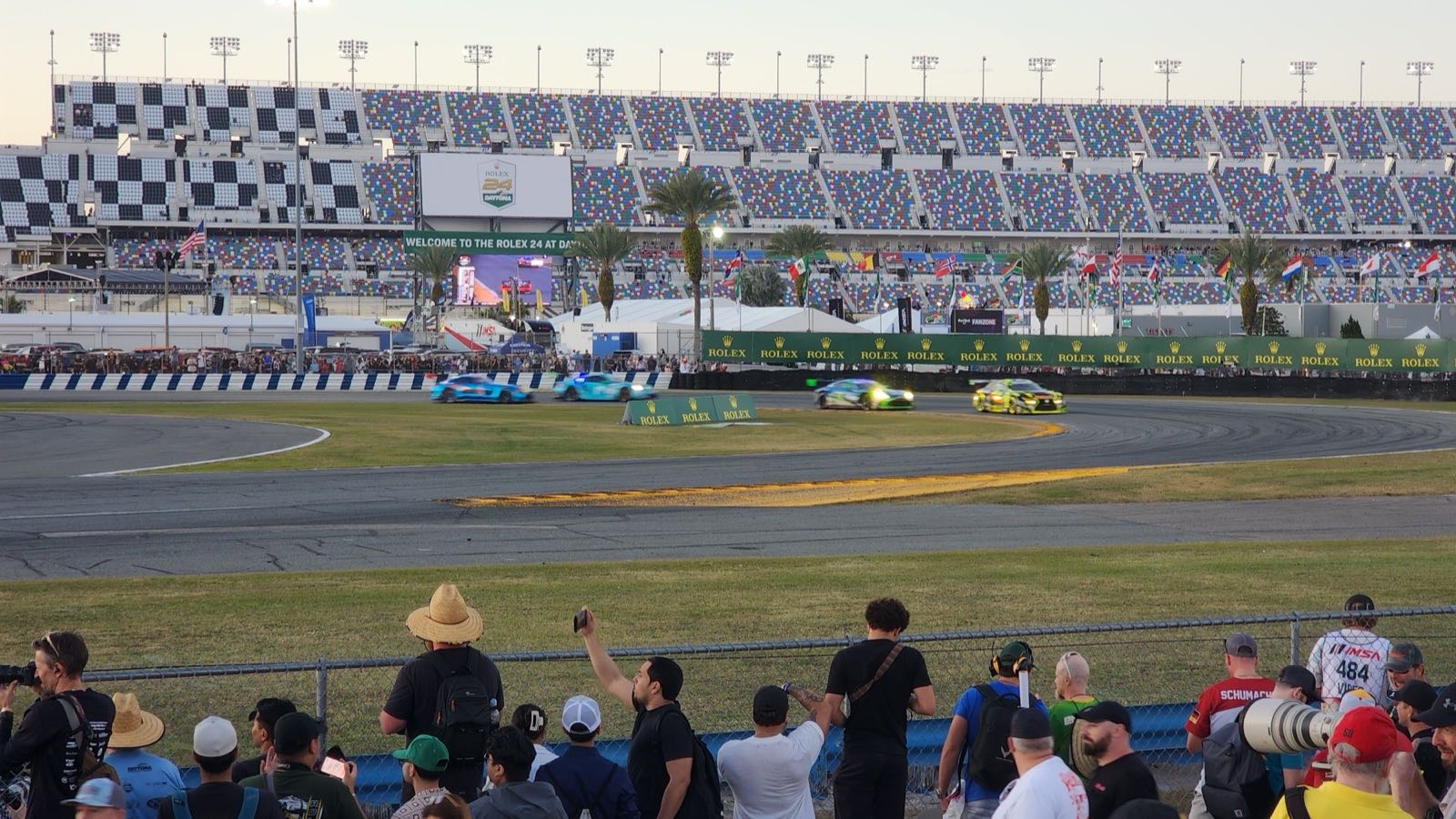
The Rolex 24 at Daytona starts mid-afternoon on Saturday and finishes mid-afternoon on Sunday. The hours in between are the hours the broadcast cannot show. The hours that decide who wins. The hours that turn the Rolex 24 into something different from any other race I attend.
I am on site for the 2027 race. I have been at it before. The middle of the night is where I learned why this race is the most rewarding endurance event on the American calendar.
What the broadcast misses
Television coverage of a 24-hour race covers maybe twelve hours of the actual event. The pre-race ceremonies, the start, the early afternoon, the dinner-hour hand-offs. Then the broadcast drops to highlights and rejoins for the morning hours and the finish.
The hours the broadcast skips are the hours the race is actually decided. Midnight to 4 AM Eastern is when the leaders settle into rhythm, when the third-string drivers cycle through, when fatigue starts to show on the third and fourth pit-stop sequences, and when the cars that will be in the final fight separate themselves from the cars that will not.
If you only watch the Rolex 24 on television, you miss the race.
What it looks like at midnight
Daytona at midnight on Saturday is quieter than people expect. The sodium-orange lighting from the speedway floods kicks in around 6 PM. By midnight, the front straight is empty of crowd movement but full of car movement. The cars pour off the banking through the chicane every twenty seconds, dive into the infield, come back through the International Horseshoe, climb back onto the banking. Twenty cars in four classes running their own pace, lapping each other constantly.
The sound is not the wall-of-sound of a packed grandstand at the Daytona 500. The sound is more like a constant overhead presence — the cars approaching, the cars passing, the cars receding into the dark. You can hear the gearbox shifts and the throttle modulation in a way that does not happen in daylight.
Standing at the infield fence at 1 AM, three rows of fans on the rail next to me, the leaders cresting Turn 1 at full throttle thirty feet from us. That is the Rolex 24.
The pre-dawn hours
3 AM to 6 AM is the most strategically important window of the race. The cars are nine to twelve hours in. The drivers have rotated through their first three stints. The teams are running on adjusted setups based on the overnight track temperature. The class leaders are usually still leading. The cars that will challenge for the win in the morning are the cars working through the field right now.
Watching the leader board at 4 AM Sunday and seeing a GTP car that started fifteenth running second is the moment you understand that the race is being run continuously while you slept earlier. The race is always happening. The team is always working. The window for a mistake is always open.
Why fans walk the venue all night
Daytona at night is the most accessible race weekend on the American calendar. The infield is open. The garages are visible. Pit road is observable from public viewing areas. The credentialed access tiers go further but a general admission fan can walk the venue at 2 AM and watch race-leading cars come down pit road for full driver-changes.
I have walked the venue at every hour of the Rolex 24. Each hour gives you a different version of the race. The 3 AM crew chief in the garage. The 4 AM fueler waiting for a green-flag stop. The 5 AM lighting that starts to mix with the first hint of pre-dawn sky on the eastern banking. The 6 AM smell of coffee from twenty different team hospitalities.
None of that exists at any other race I plan trips to.
What changes in the morning
7 AM to 10 AM is the recovery window. The cars that ran clean overnight are now within striking distance of the lead. The cars that lost laps to incidents are working back. The morning weather almost always cools the track surface, which changes lap times by a half-second or more. Strategy from the overnight hours becomes visible in the running order.
By 10 AM the crowd is rebuilding. By noon the venue is full again. The final two hours from 12 PM to the finish at roughly 1:30 PM Sunday is the second crescendo of the weekend. The first crescendo was the start. The second is the chase to the checkered flag.
If you came for the start and missed the overnight, you saw half the race. If you saw the overnight, you saw the whole story.
How to plan around the night hours
The professional approach for the Rolex 24 is this: watch the start at 2 PM Saturday. Sleep in your hotel from midnight to 4 AM. Get up for the pre-dawn hours. Come back to the hotel for two hours at 9 AM. Be back at the venue for the final stretch.
That is what I do most years. That is what the package is built around. Hotel three blocks from the gates. Walking distance. The room is the rest station, not the destination. The overnight is also the part a guide changes the most, which is why I offer a guided Rolex 24 host experience for anyone who wants me beside them reading the race through the night.
The full planning guide is at How to Plan a Rolex 24 at Daytona Trip. The comparison with the Daytona 500 is at Rolex 24 vs Daytona 500: Which Daytona Trip Should You Book?. The 2027 trip page is at 2027 Rolex 24 at Daytona, one of our Rolex 24 at Daytona packages.
Bottom line
The Rolex 24 is the most rewarding endurance race weekend on the American calendar because the hours other races do not have are the hours that matter most. The midnight stretch. The 3 AM pit walk. The pre-dawn lap times. The morning that turns into the finish.
Tell us where you are coming from. The hotel and the access tier get built around what you want from the night.
Frequently asked questions
What happens during the Rolex 24 overnight?
The Rolex 24 runs continuously through the night without a break. Cars cycle drivers every two to three hours. Teams adjust setups based on the cooler overnight track temperature. The class leaders typically extend their leads or get caught by recovering cars. The middle-of-the-night hours often decide which cars are in contention for the final chase to the checkered flag Sunday afternoon.
Can fans stay at Daytona International Speedway overnight?
Yes. General admission allows fans to stay at the venue across the full 24 hours. The infield, garage viewing areas, and pit road observation points are accessible through the night. Premium hospitality tiers include lounges with food and beverage service that operate overnight. The featured hotel is three blocks from the gates if you prefer to sleep in a bed.
What is the most important overnight window at the Rolex 24?
The 3 AM to 6 AM pre-dawn window is the most strategically important. The cars have settled into rhythm, the third-string drivers have cycled through, and the cars that will challenge for the win in the morning are typically working through the field at this hour. Incidents in this window often change the running order in ways that determine the final result.
Do the cars run at full speed through the night?
Yes. The Rolex 24 runs at race speed continuously for 24 hours. The cars are not pacing themselves overnight. Track temperature and tire wear change the strategy, but lap times in the middle of the night are often within a half-second of daytime pace. Endurance racing is not slow racing.
What does it sound like at Daytona at 2 AM?
Daytona at 2 AM is quieter than a race-day daytime stretch because the crowd is reduced and the cars are more spaced out. The sound is closer to a continuous overhead presence than a wall of sound. Individual gearbox shifts, throttle inputs, and tire scrub are audible in a way that does not happen during the day.
Should I sleep through the night at the Rolex 24?
Most fans plan to sleep some portion of the overnight. The professional approach is to watch the start, sleep midnight to 4 AM, get up for the pre-dawn hours, sleep again briefly mid-morning, and be back at the venue for the final two hours. Trying to stay awake the entire 24 hours is rarely worth it; you will be exhausted for the finish.
Why is Robert on site at the Rolex 24?
The Rolex 24 is one of the trips Racing Passport hosts on the ground. Robert leads the on-site experience including pit lane access, grid walk, Victory Lane access, and the access elements that turn a general visit into a race-weekend immersion. The Rolex 24 makes the cut alongside the Indianapolis 500, the US Grand Prix at Austin, and the NASCAR Championship Weekend at Homestead.