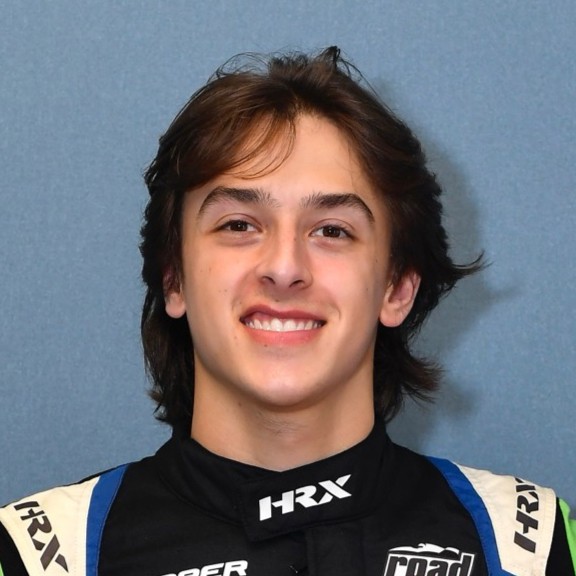
In late February of 2020, just days before the world shut down for COVID, Prescott Campbell sat down with me for a 33 Dreams of Indy episode. He had just won the 2019 Lucas Oil Formula Car Series championship. He had just signed with Exclusive Autosport for the upcoming USF2000 season. He had spent the 2019 Indianapolis 500 working as an intern with Dale Coyne Racing, doing 3D-printed driver-cooling assemblies in the pit lane. He was nineteen years old.
Neither of us knew, sitting there on that call, that the entire 2020 motorsport calendar was about to be rearranged. The first race of the USF2000 season at St. Petersburg was three weeks away. It would not run. Nothing would run for months. Prescott’s first full season in cars was going to look nothing like the one he had just walked me through.
He was also, at that moment, on a plane back and forth between California and Oxford, England, because he was enrolled at Oxford Brookes University in Motorsport Engineering. He had picked the school specifically. He explained why on the episode in a way that, looking back from today, was almost a prediction.
“If I wanted to work at the pinnacle of engineering, particularly in motorsport,” he said, “this is where I had to go.”
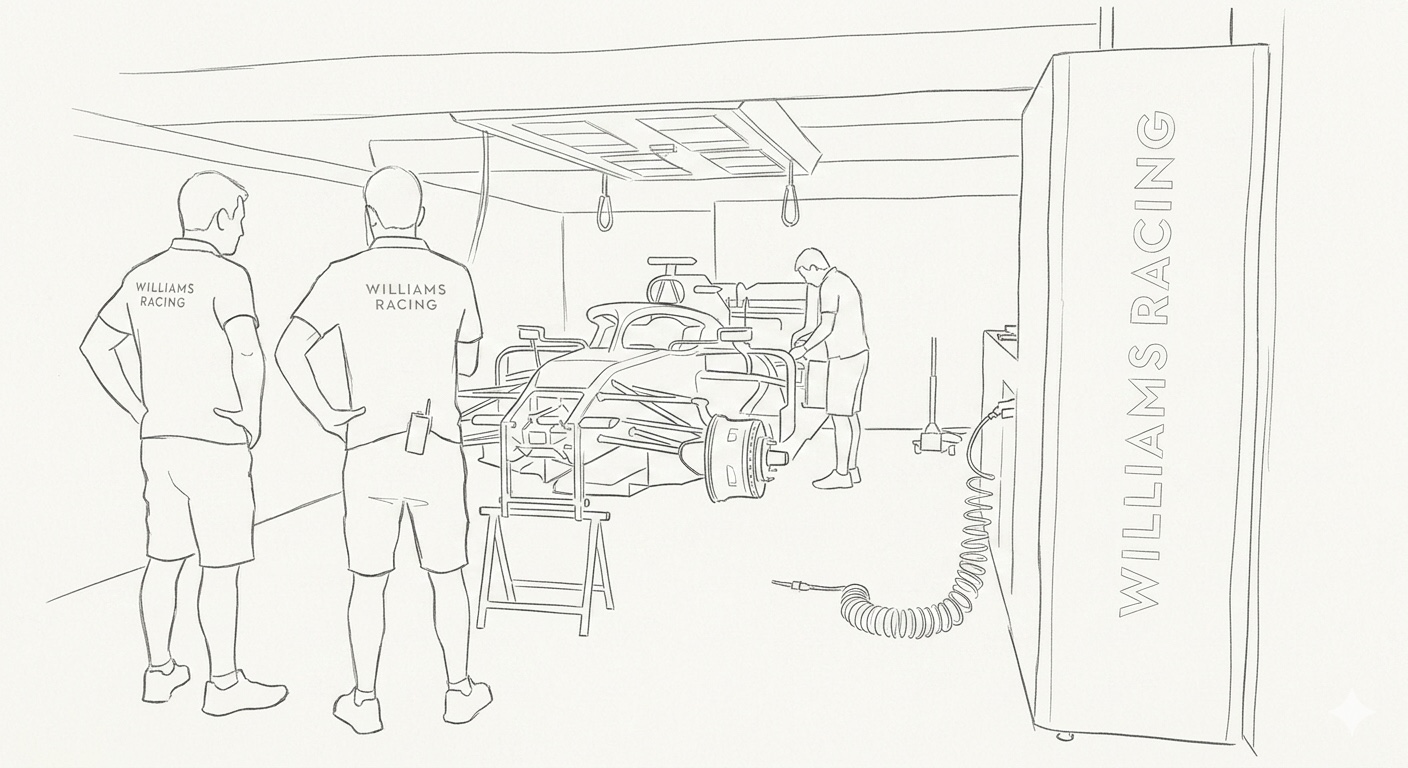
Five years later, the prediction has come true. Prescott Campbell is now a Structural Engineer at the Atlassian Williams F1 Team. Sir Frank Williams’s team. Sir Patrick Head’s design heritage. The team that put Mansell and Hill and Villeneuve into championship cars. That is where Prescott shows up to work now.
This piece is the update. It is also the part of the 33 Dreams story I love telling, because it is the part where the dream you started with bends into a dream you did not know you were aiming at, and turns out to be the better version of the dream.
Here is the original interview. Recorded late February 2020, three weeks before COVID locked the world down. Worth the watch if you want to hear Prescott’s voice on the path he thought he was on, before the path bent.
Prescott Campbell on 33 Dreams of Indy, February 2020. The conversation that set up everything in this piece.
The 2019 plan
The conversation in 2019 was about driving. Prescott had come up through karting in California. He had moved through cadet karts to shifter karts, gotten to the s1 Pro level, then transitioned into cars through the Cooper Tire scholarship shootout at the end of 2018. He won the Lucas Oil Formula Car Series in 2019 while finishing his last year of high school AND running pro-level shifter karts on the side AND recovering from a broken femur from a karting accident at a club event in late June of that year. He missed three rounds of the Lucas Oil series because of the injury, came back, won at the National Corvette Museum on his first race back, and finished second at Sebring to take the title.
The story he told me on the show was the racer’s story. The plan was to keep climbing the Road to Indy ladder. USF2000 in 2020. Then Indy Pro 2000. Then Indy Lights. Then the IndyCar Series. Eventually, the goal he said out loud at the end of the episode, the Indianapolis 500.
I asked him what it would be like to qualify for the 500. His answer was the one every young driver gives, which is also the one every young driver means when they give it. “Unbelievable. To feel all the hard work that I had done up to that point finally turn into an accomplishment like that. To compete in the race and demonstrate my ability in front of one of the most watched races in the world.”
That is the dream he came on the show to chase.
The Oxford Brookes choice was the pivot
Here is the part of the 2019 conversation that, in hindsight, was the actual story.
I asked him about Oxford Brookes. About the program. About why a kid from Newport Beach with a USF2000 scholarship to sign was flying back and forth to England to attend a school in Oxfordshire while trying to win a championship in America.
He told me his interest in engineering came from his parents (both engineers) and from watching Formula 1 from a very young age. He told me Formula 1 is the pinnacle of engineering of every industry he had looked at, one of the fastest moving engineering industries in the world. He told me he wanted in.
Then he told me how he had found Oxford Brookes. He had heard the story of one of the engineers in IndyCar, the road to which traced back to Brookes. He looked into the school. The alumni network in Formula 1 turned out to be unlike any other school’s. Every single F1 team has Brookes graduates inside it. He put everything into his application.
“If I wanted to work at the pinnacle of engineering, particularly in motorsport,” he said, “this is where I had to go.”
The line was easy to miss in the middle of a forty-minute racing interview. It was the most important sentence he said.
What he is doing now
Five years out from that episode, Prescott graduated from the Brookes Motorsport Engineering program. He took the engineering road instead of the driving road. He landed at the Atlassian Williams F1 Team in a Structural Engineer role.
For people outside the engineering side of motorsport, a Structural Engineer at an F1 team is the person doing the analysis and design work that makes sure the parts on the car can survive the loads they are about to be put under. The aero loads. The crash loads. The vibration. The fatigue cycles. Modern F1 cars are designed around a millimeter-by-millimeter optimization of weight versus rigidity, and the structural engineers are the people who decide what stays and what gets cut. The job sits at the intersection of CAD design, finite element analysis, materials science, and an understanding of what the car is actually doing on track.
Williams is also one of the most interesting places in the F1 paddock right now. The team has been rebuilt under James Vowles, has invested heavily in infrastructure (the parts of an F1 organization that compound for years), and is climbing the constructors’ table with serious momentum. The young engineers showing up there now are going to be on the cars when the team is back in the front-running conversation. If you are in your twenties and you want to be inside an F1 program at the moment it bends back up, Williams is exactly where you want to be.
What this means for fans
Here is why this story matters, in a Racing Passport context.
The path Prescott took is the path you should know exists. Every Formula 1 grid has 22 drivers on it. The driver path is real, but it is narrow, and most of the people who love F1 enough to build a career around it do not end up sitting in one of those 22 cockpits. What they end up doing instead is becoming the people who put the cars on the grid. The aerodynamicists. The race engineers. The strategists. The structural engineers. The materials specialists. The mechanics. The data analysts. Thousands of people, across every team, every weekend, making the show happen.
Prescott is now one of those people. The 2019 plan was to drive in F1. The 2026 reality is being in F1 in a way that, in some respects, is more durable than the driving career he was aiming at. Driving careers end on a timeline F1 sets. Engineering careers end on a timeline you set. The dream he came on the show to chase, the world’s pinnacle of motorsport engineering, he is now living.
A specific note on what that actually looks like. The structural-engineering work happens in the design office at Williams headquarters, not on race weekends. Prescott is not at the track for the Grands Prix unless an emergency situation requires him to be there. The cars he helps engineer go to the races. He, like most of us, watches the races from somewhere other than the paddock.
Which is the part that ties straight back to what Racing Passport does. The people who design the cars do not get to be at the races as a perk of the job. The fans do. The way you experience an F1 weekend from the inside is the way Racing Passport plans it. With the access, the hotel, the paddock club where it is available, the right grandstand, the right transfer, and the right Saturday-night dinner. The engineers building the cars are running them remotely. The trip is for the people who want to be in person.
That is the better version of the story. That is the one I love telling.
See the team he works for, in person
This is where the trip part comes in.
If you are reading this and you have not yet stood inside an F1 weekend, the experience is different than watching it on television. You feel the energy. You see the team garages. You see the structural decisions Prescott and his colleagues made show up on the cars under the lights. You see the part of the sport that the broadcast cannot show you.
Racing Passport plans the trips. The Williams cars are at every race on the F1 calendar. The 2026 and 2027 calendar weekends we have on the page include:
The Italian Grand Prix at Monza is Ferrari’s home race but the historic home of European motorsport engineering. Williams, Ferrari, McLaren, all of them. The tifosi are in the stands, the cars are in the paddock, and the engineering is the whole point of the weekend.
The United States Grand Prix at Austin is one of the F1 weekends I am personally on the ground for. Circuit of the Americas. Invitation only and small.
The Singapore Grand Prix is F1 under the lights at Marina Bay.
The Las Vegas Grand Prix is F1 down the Strip after dark.
The Abu Dhabi Grand Prix is the season finale.
The Monaco Grand Prix is the Triple Crown race and the most iconic weekend on any motorsport calendar in the world.
Any of these is the trip where you stand in a paddock and realize that the people in the team garages, the ones in the headsets, the ones with laptops at the engineering benches, were drivers once too. Some of them still are. Some of them found a different door.
The 33 Dreams takeaway
I have been doing the 33 Dreams of Indy series for years now. The framing of the show is that every year, hundreds of drivers, dozens of teams, multiple series chase one ultimate goal: the Indianapolis 500. Only thirty-three dreams come true.
What I have learned doing the show is that the dream takes shapes you do not always predict at age nineteen. Some of the drivers I interviewed reached IndyCar. Some are racing GT cars and loving it. Some are coaching. Some are owning teams. And Prescott Campbell, who came on the show to talk about driving in USF2000, is now structurally engineering Formula 1 cars at Williams.
The dream came true.
Keep dreaming.
Read next
- Gateway to the Last 7 Years — the journey from my first credentialed IndyCar weekend at Gateway in 2019 to where the 33 Dreams archive sits now.
- Three Drivers You Will One Day Wish You Saw Race in Person — Hamilton in F1, Palou in IndyCar, Hamlin in NASCAR, and why timing matters.
- What Racing Passport Actually Does — the explainer for how Racing Passport plans the trip.
- Indy is Life — why the Indianapolis 500 sits at the center of everything Racing Passport does.
- Planning a Luxury Motorsport Trip — how a curated weekend gets built.