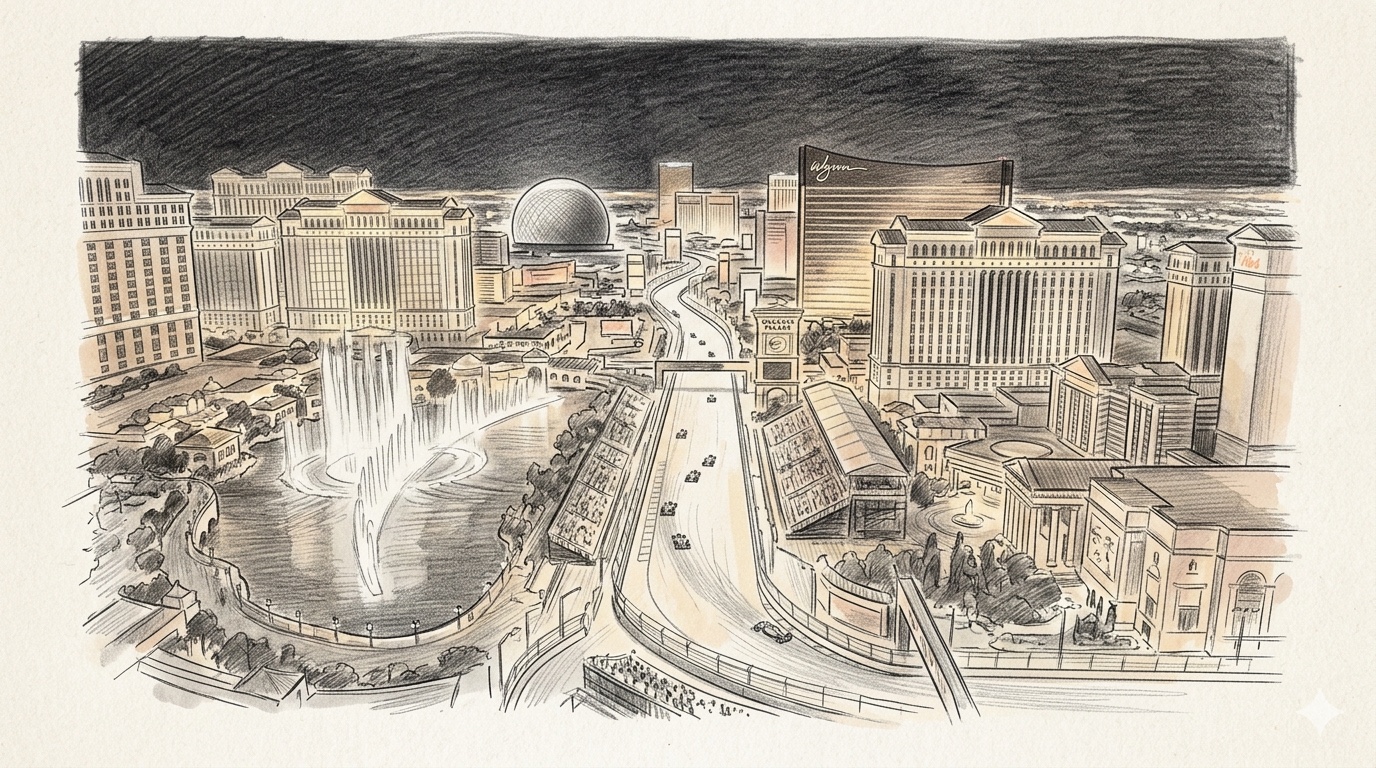
The Las Vegas Grand Prix is the F1 race on the Las Vegas Strip.
The race returned to the F1 calendar in 2023. Formula 1 had been to Las Vegas before, briefly, in 1981 and 1982 at a temporary circuit in the Caesars Palace parking lot. That race did not become a tradition. The 2023 return was a completely different project. Liberty Media built the new Las Vegas Strip Circuit through the heart of the Strip itself, with the Bellagio Fountains, the Sphere, the Wynn, the Bellagio, Caesars Palace, the Cosmopolitan, and the Aria as track-side architecture. The Strip becomes the venue for race week.
The Las Vegas Grand Prix runs on Saturday night. This is the only race on the F1 calendar that is not held on Sunday. The Saturday timing is calibrated for the Las Vegas commercial week, for the television markets in Europe and Asia, and for the city’s existing weekend rhythm. The race starts at roughly 10 PM local time. Cars finish the race after midnight.
The Strip is closed for race week. Pit complexes are temporary. Grandstands assemble around the circuit. Hotels along the Strip become race-week hospitality buildings, with balconies, terraces, and rooftop spaces operating as race-day viewing platforms. The combination of the existing Strip infrastructure and the F1 weekend overlay is unlike any other race on the calendar.
For premium F1 travelers, a Las Vegas Grand Prix trip is structurally different from every European and Asian race. The destination already exists at a saturated premium tier. Hotels are dense. Restaurants are everywhere. Dining and bar service runs through the night by design. The base city is the destination, the venue, and the post-race experience all at once.
This is a planner’s guide to that combination. No pricing. The pricing conversation is downstream of the planning conversation. This piece is the planning conversation. For the general framework of planning a premium F1 trip across any venue on the calendar, the planner’s guide for premium F1 is the hub piece this article links back into.
The Las Vegas Grand Prix in context
The 2023 return of Formula 1 to Las Vegas was a Liberty Media project. The Vegas race had been the headline goal of F1’s American expansion strategy. Liberty acquired land, built a permanent pit and paddock complex off-Strip, designed the circuit, and executed the operational logistics of running an F1 race through the heart of one of the busiest entertainment districts in the world.
The 6.201-kilometer circuit runs north on the Strip from the off-Strip paddock area, past the Sphere and east into the Convention Center district, then west and back south down the Strip past the Bellagio, the Cosmopolitan, the Aria, and the Wynn. The pit complex is a permanent multi-story facility, not the temporary structures used at street circuits like Singapore.
The Saturday night scheduling is the defining feature. Practice sessions run Thursday and Friday nights. Qualifying is Friday night. The race is Saturday night. The entire weekend operates on a nocturnal calendar. Most premium attendees are on a flipped schedule across race week, sleeping in the morning and active from late afternoon into the early hours.
The crowd profile at Las Vegas is different from the European races. The audience is heavily American, with strong Mexican, Canadian, and Latin American attendance. The dominant fanbase from the rest of the F1 calendar — the tifosi, the Dutch Orange Army, the Williams home crowd at Silverstone — is less concentrated at Las Vegas. The crowd is more multinational and the on-circuit atmosphere is more music-festival than home-team Grand Prix.
How a Las Vegas race weekend actually runs
The on-track weekend at Las Vegas runs on a unique calendar shaped by the night-race format and the Saturday race day:
- Thursday: free practice 1, late evening
- Friday: free practice 2 and qualifying, late evening into the early hours
- Saturday: the race, starting at roughly 10 PM local time, finishing after midnight
The off-track shape for a premium attendee:
Wednesday or Thursday. Arrival day. Most premium travelers arrive Wednesday or Thursday to handle the time-zone adjustment and the flipped schedule. Vegas is three hours behind US Eastern Time and on a different rhythm from any European base.
Thursday night. Premium hospitality programs at the circuit open Thursday for the first practice session. The Strip is already in race-week mode.
Friday night. Practice 2 and qualifying. The Strip is at full intensity. Race-week dinner reservations and casino activity peak.
Saturday night. Race night. The defining experience. The race finishes after midnight. Post-race continues into the early hours with the city’s standard late-night operating mode.
Sunday. Recovery day or departure. Most premium travelers either fly home Sunday or extend the trip with a Sunday afternoon and Monday departure.
Monday onward. Departure day or the start of an extension. The Las Vegas Grand Prix is a launchpad for onward American or Mexican travel.
The Las Vegas rhythm is unique on the F1 calendar. The nocturnal Saturday-race format means the trip operates on a flipped schedule. Premium attendees sleep through morning sessions, eat breakfast in the early afternoon, and are at the circuit from late evening through the early hours.
Where to base yourself
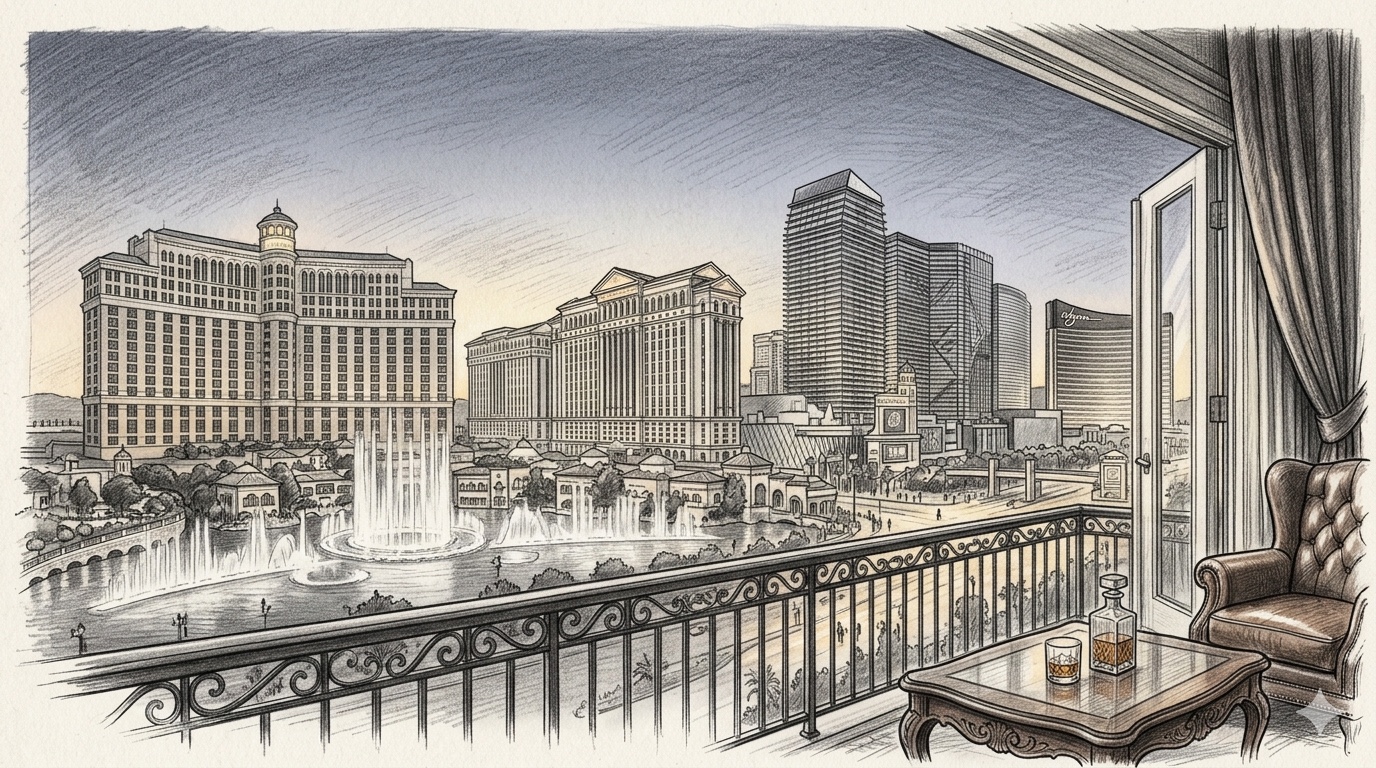
Las Vegas has the densest premium hotel inventory of any F1 venue on the calendar. The base decision is which Strip property fits the trip.
The Bellagio. Central Strip. The fountains overlook the circuit. Race-week balcony and terrace viewing from select rooms. Iconic Las Vegas premium base.
The Cosmopolitan of Las Vegas. Central Strip, adjacent to the circuit. Specific suites and the Chelsea Tower overlook portions of the track. Strong race-week base for travelers who want trackside hotel access.
Wynn and Encore. North-central Strip. The circuit runs past the front of the property. Race-week viewing from suites and terraces. Strong premium base.
Aria. Central Strip, set back from the racing line but with race-week hospitality programs.
Caesars Palace. Central Strip. Historic Las Vegas premium. Race-week balcony viewing from select suites.
Resorts World. North Strip. Newer property with premium tier. Race-week hospitality programs.
Park MGM and Vdara. Central Strip. Premium options at slightly different tiers.
The base decision depends on which side of the circuit the buyer wants to view from, on the specific hospitality program access, and on the post-race walking distance. Most premium attendees at Las Vegas choose a Strip property and walk to circuit-adjacent hospitality from there.
Hospitality and viewing options at Las Vegas
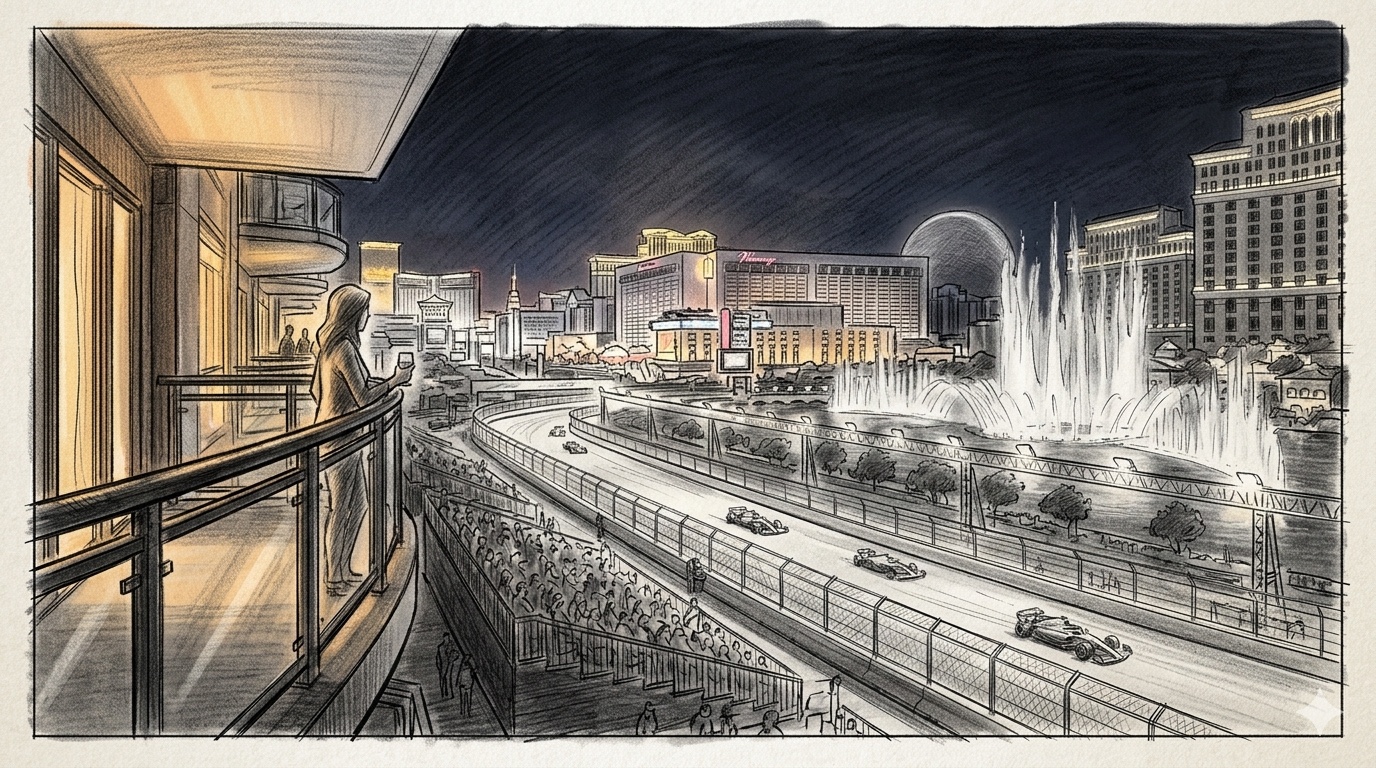
The Las Vegas hospitality landscape is unique to the venue because the Strip itself is the architecture of race week.
Paddock Club. The official F1 hospitality program operates at the Las Vegas Strip Circuit the same as at every venue. The Vegas Paddock Club implementation includes paddock-side suites with views of the pit complex and circuit, and the catering and service tier consistent with the highest-end Paddock Club venues.
Hotel balcony and terrace viewing. This is the category unique to Las Vegas. Strip hotels with rooms or suites overlooking the circuit operate as race-night viewing platforms. The Bellagio, the Cosmopolitan, the Wynn, Caesars Palace, and Resorts World all have configurations where specific room categories deliver direct race-night track viewing. This category does not exist at any other F1 venue at the same density.
Skybox and corporate hospitality. Multi-story temporary hospitality structures along the circuit operate during race week. The Wynn Skybox, the Bellagio Fountain Club, the Bellagio Grand Stand, and similar premium hospitality buildings deliver race-day viewing with private catering and lounge service.
Premium grandstands. Grandstand sections along the Strip at the most iconic viewing locations — the Bellagio Fountains, the Sphere, the start-finish straight — operate at premium-tier service. Strong race-night experience at lower commitment than full hospitality.
Yacht-equivalent and rooftop programs. Specific rooftop venues across the Strip operate race-night hospitality programs. The Sphere itself, the High Roller observation wheel, and certain casino tower rooftops become race-week venues.
The right tier at Las Vegas depends on whether the buyer wants the trackside-inside-the-paddock experience (Paddock Club) or the trackside-with-Strip-skyline experience (hotel terrace, Skybox, premium grandstand). Both are valid. The Strip-skyline option is the differentiator at this venue.
The transfer reality
Las Vegas is the easiest F1 venue on the calendar for premium transfers and one of the friendliest for race-week logistics.
Harry Reid International Airport is roughly fifteen minutes from any Strip hotel. The Strip itself is dense and walkable, especially for premium attendees based at central Strip properties. Race week traffic on the Strip is heavy but the F1 weekend itself runs in the late evening when the Strip is at its normal operating intensity.
Transfer options most premium travelers consider:
Walking. From most central Strip premium hotels, the circuit and the trackside hospitality venues are walkable. This is the standard race-night logistics solution for travelers based at the Bellagio, the Cosmopolitan, the Wynn, Caesars Palace, or the Aria.
Private driver. Used primarily for airport transfers and for off-Strip dining or activities. Less essential for race-night logistics than walking.
Rideshare. Uber and Lyft are abundant. Race-night demand peaks after the race finishes after midnight. Surge pricing is common.
Helicopter or fixed-wing for arrivals. Some premium travelers arrive via private aviation. Harry Reid International handles general aviation, with Henderson Executive Airport and North Las Vegas Airport as alternatives.
The transfer plan at Las Vegas is rarely the operational bottleneck. The geography is friendly and the race-week logistics are well-managed.
The American extension
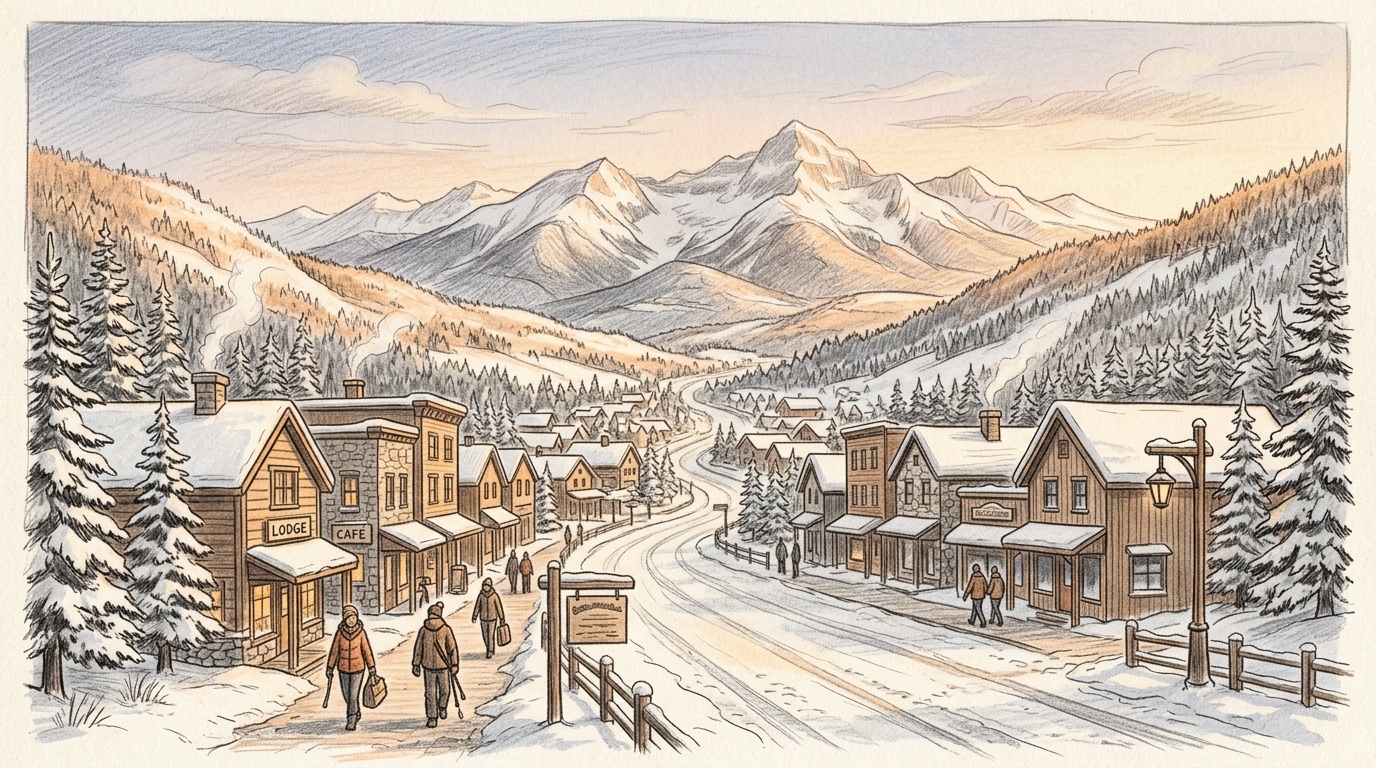
The Las Vegas Grand Prix sits at a unique launching point for an American or Mexican extension. The late-November timing aligns with the start of the winter season in the western United States.
The common extensions:
Aspen, Park City, and the ski states. Late November in Aspen, Park City, Telluride, Jackson Hole, and the broader western US ski destinations is opening weekend or early season. Premium ski week as a Las Vegas Grand Prix back-end is a recurring premium itinerary.
Los Angeles. A short flight or a four-hour drive west. The Beverly Hills, Santa Monica, and Malibu premium tier. Race weekend plus LA week is a common structure.
San Francisco and Napa. A short flight northwest. The Bay Area plus Napa wine country premium tier.
Grand Canyon, Zion, Bryce, and the national parks. Adjacent to Las Vegas geographically. Short flights or driver-route extensions into the national park system. Aman Amangiri at the edge of the Grand Staircase-Escalante is a particularly premium option.
Cabo and the Mexican Pacific. Short flight south. Los Cabos premium resort tier as a winter beach extension.
Mexico City. A medium flight south. Different cultural rhythm, strong food and architecture, premium hotel inventory growing.
New York. A cross-country flight. East Coast extension for travelers who want urban contrast.
Onward Asian or European travel. Some premium travelers structure the trip as Las Vegas plus an onward flight to Tokyo, Hong Kong, or Europe.
The right extension depends on what the trip is meant to deliver. Skiing for the winter contrast. LA or San Francisco for additional American urban. Aman Amangiri or the national parks for landscape decompression. Cabo or Mexico City for the southern extension.
When to plan a Las Vegas Grand Prix trip
The realistic minimum planning horizon for a premium Las Vegas Grand Prix trip is nine to twelve months. The realistic horizon for the top-tier Strip suites with race-week balcony access is closer to twelve to eighteen months.
The inventory cycle:
Hotel inventory at the top Strip properties with race-week viewing access is committed through hospitality networks well in advance. Specific rooms and suites with confirmed circuit-side views are the most constrained inventory category.
Paddock Club allocation at Las Vegas runs on the F1 cycle.
Premium grandstand and Skybox inventory along the Strip is released through hospitality networks before public availability.
Race-week dinner reservations at the iconic Las Vegas restaurants book months in advance. The chef-driven properties along the Strip and the destination restaurants in the off-Strip dining scene are particularly competitive for race week.
The buyer who starts planning six months ahead can still build a Las Vegas Grand Prix trip. The top-tier circuit-view rooms may be unavailable. Strong premium alternatives still exist.
Why an advisor matters at Las Vegas specifically
The advisor case for Las Vegas is concentrated in two areas.
First, the hotel inventory with confirmed race-week trackside viewing. Specific room categories at the Bellagio, the Cosmopolitan, the Wynn, Caesars Palace, and Resorts World deliver race-night track viewing. Most of those rooms are committed through hospitality networks before public booking opens. The advisor with the right relationships sources rooms the public booking window will not show.
Second, the hospitality program access. Skybox, Bellagio Fountain Club, Wynn Skybox, and the various premium hospitality buildings along the circuit are allocated through specific programs. Direct public booking is limited.
The race weekend logistics are operationally simpler than Monaco or Singapore. The complexity is in the inventory access and the specific Strip-property fit for the trip the buyer wants.
Common questions about a Las Vegas Grand Prix trip
When is the Las Vegas Grand Prix held?
The Las Vegas Grand Prix is typically held in November, late in the F1 season. The exact dates vary year to year. The race itself runs on Saturday night, starting at roughly 10 PM local time and finishing after midnight.
Why does the Las Vegas Grand Prix run on Saturday instead of Sunday?
The Saturday-night timing is calibrated for the Las Vegas commercial week, for European and Asian television markets, and for the Strip’s existing weekend operating rhythm. The Saturday race is one of the defining features of the Las Vegas Grand Prix on the F1 calendar.
Where should I stay for the Las Vegas Grand Prix?
A Strip hotel with race-week viewing access is the default premium answer. The Bellagio, the Cosmopolitan of Las Vegas, the Wynn, Caesars Palace, the Aria, and Resorts World are the typical premium bases. Specific room categories at each property deliver race-night track viewing.
What is special about the Las Vegas Grand Prix?
Las Vegas is the only F1 race on the calendar that runs on Saturday rather than Sunday. The circuit threads through the heart of the Las Vegas Strip itself, with the Bellagio Fountains, the Sphere, the Wynn, and Caesars Palace as track-side architecture. The combination of the existing Strip infrastructure, the late-night race-time, and the multi-day Las Vegas hospitality environment is unique on the calendar.
Is Paddock Club worth it at Las Vegas?
It depends on what the buyer wants from the weekend. Paddock Club at Las Vegas is excellent. The hotel balcony and terrace viewing from specific Strip properties is a credible alternative at the premium tier and is unique to Las Vegas among F1 venues. The right tier depends on whether the buyer wants the inside-paddock experience or the Strip-property-balcony experience.
How does the late-night race format affect the trip?
The Saturday night race format means the entire trip operates on a nocturnal calendar. Practice sessions Thursday and Friday run late evening. Qualifying Friday night runs into the early hours. The race itself finishes after midnight. Premium travelers typically sleep through the morning across race week and are active from late afternoon onward.
How long should a Las Vegas Grand Prix trip be?
The race weekend itself runs Thursday through Sunday or Monday. Premium travelers commonly extend the trip into a western US destination (Aspen, Park City, Los Angeles, San Francisco, Napa, the national parks) or a Mexican extension (Cabo, Mexico City). A week is the standard premium trip length.
Why do I need a travel advisor for the Las Vegas Grand Prix?
The Strip hotel inventory with confirmed race-week trackside viewing is committed through hospitality networks well in advance. Hospitality program access at Skybox, Fountain Club, and similar premium buildings is allocated through specific programs. The advisor sources the inventory the public booking window will not show and orchestrates the multi-night Strip experience to fit the trip the buyer wants.
How to start the conversation
The right time to plan a Las Vegas Grand Prix trip is earlier than feels intuitive. Nine to twelve months ahead is the realistic minimum. Twelve to eighteen months ahead is normal for the top-tier Strip suites with race-week balcony access.
Tell us the year, the group, the Strip property preference, and any extension interest (skiing, LA, San Francisco, the national parks, Cabo, Mexico City). We come back with the plan.
See the 2026 Las Vegas Grand Prix trip page →
Read next
- How to Plan a Premium Formula 1 Trip — the planner’s guide for the first-time premium F1 traveler across the calendar.
- How to Plan a Monaco Grand Prix Trip — the planner’s guide for the bucket list race.
- How to Plan an Italian Grand Prix Trip — Monza, the tifosi, Milan as the base, the Lake Como extension.
- How to Plan a Singapore Grand Prix Trip — the night race, the Marina Bay base, the Southeast Asia extension.
- How to Plan an Abu Dhabi Grand Prix Trip — the season finale, the Yas Hotel, the Dubai and Maldives extensions.
- How to Plan a United States Grand Prix Trip — Circuit of the Americas, Austin as the base, the Hill Country and Texas extension.
- How to Plan a Miami Grand Prix Trip — Hard Rock Stadium, South Beach as the base, the Florida and Caribbean extension.