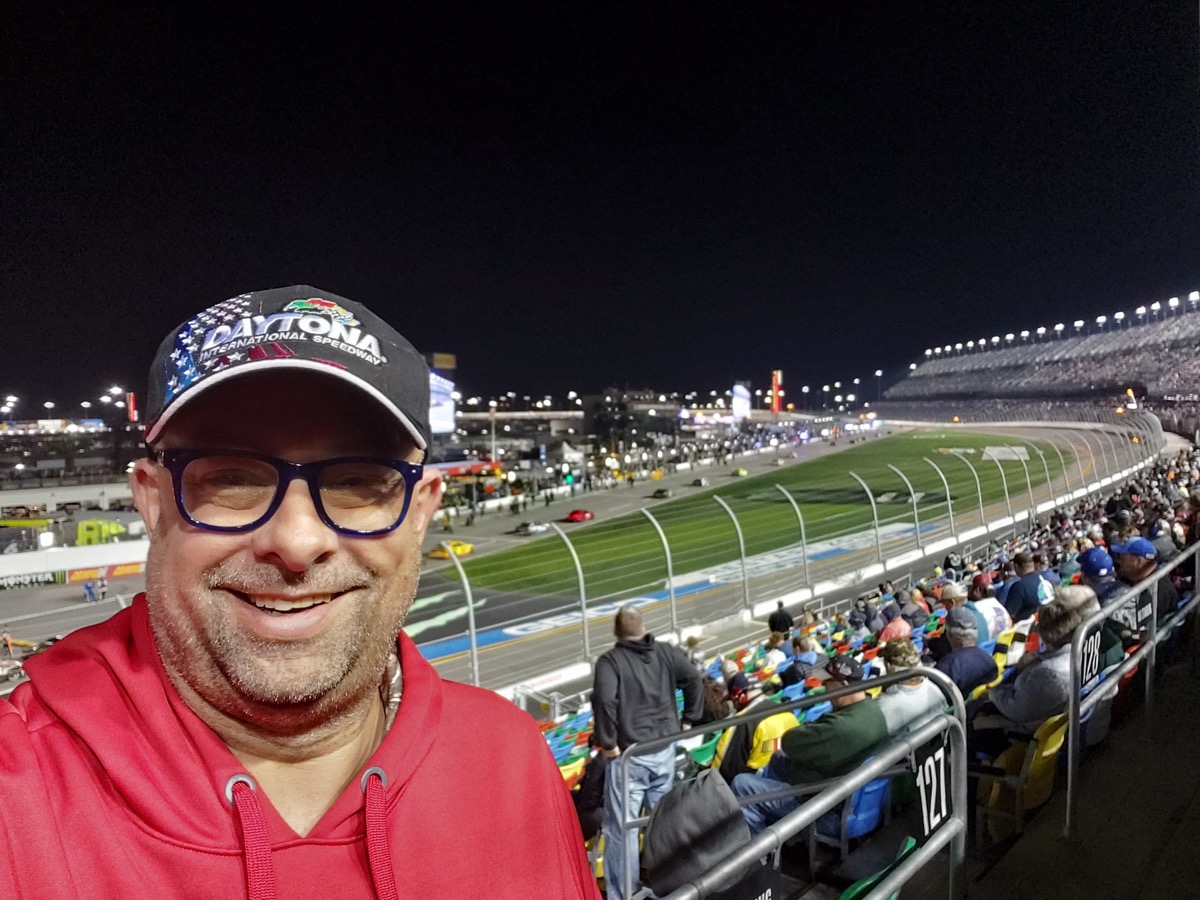
The Daytona 500 is the one race a year where the whole field runs as a single pack for 500 miles, and that changes what a good seat is. At a 2.5-mile superspeedway you are not watching one corner, you are watching forty cars move as one down the banking and through the tri-oval. Where you sit decides how much of that you actually see. This is a guide to the grandstands, the sightlines, and how to plan the week around the race.
Why the seat works differently at a superspeedway
Most tracks reward a seat near one specific corner. Daytona does the opposite. Superspeedway racing bunches the entire field nose to tail in drafting packs, and the story of the race is the pack: where it forms, how it splits into lanes, when a run develops, and where it all comes apart. That story plays out across the whole 2.5-mile oval, not at one point on it.
So the question at Daytona is not which corner. It is how much of the lap you can see at once. The answer is the frontstretch, and the answer is high.
The frontstretch grandstand
Daytona rebuilt its frontstretch grandstand from the ground up in the Daytona Rising project, finished in 2016. The result is a single towering frontstretch structure with wide concourses, escalators, and five main entrances the track calls injectors, each opening onto its own section of seating. Nearly all of the permanent seating at the speedway lives in this one frontstretch grandstand. There is no big backstretch grandstand to choose instead, which simplifies the decision: you are picking your spot along the front stretch and, more importantly, how high you sit.
From the upper levels of the frontstretch grandstand you can see almost the entire 2.5-mile lap. You watch the pack come off Turn 4, fan out through the tri-oval to the start-finish line, stream down into Turn 1, and run the back of the track in the distance. That full-lap view is the single best thing about a Daytona seat, and it is only available up high.
Sit high. It matters more here than anywhere.
If you take one thing from this guide, take this: at Daytona, height beats everything. A lower seat on the frontstretch puts you close to the cars as they scream past the start-finish line, which is a thrill for a lap, but you lose the pack the instant it leaves the tri-oval. A high seat trades a little of that close-up noise for the thing you came to a superspeedway to see, the whole draft working around the entire oval.
The higher rows also give you the run to the checkered flag. Daytona finishes are decided by which lane gets a push and when, often in the last hundred yards through the tri-oval, and from up high you see the run build a full lap before it arrives.
Where the tri-oval and the start-finish sit
The tri-oval is the kink in the frontstretch where the grandstand bends, and seats there put the start-finish line and the run to the flag directly in front of you. This is the classic Daytona 500 seat: pit road below, the flag stand ahead, and the pack pointing straight at you as it comes for the line. Combine the tri-oval location with a high row and you have the best all-around seat in the house.
Seats toward the Turn 1 end of the grandstand give you the entry where the pack first commits to a lane after the start, and seats toward the Turn 4 end give you the exit run onto the frontstretch. Both are strong. The tri-oval center is the default for a reason.
The week, not just the race
The Daytona 500 is the opening race of the NASCAR Cup Series season, which is backwards from most sports and is exactly why it carries so much weight. The biggest race of the year is the first one, so a season can be made in February.
It is also the end of a full week of racing, not a standalone Sunday. The Duel qualifying races run on the Thursday night before and set the field. The ARCA cars, the Craftsman Trucks, and the Xfinity Series all race across the days that follow, and the atmosphere builds the whole time. That is why so many people treat the Daytona 500 as a week rather than a day, and why the where-to-stay question is worth as much thought as the where-to-sit one.
Where to stay
Daytona Beach is an oceanfront town, and the speedway sits less than two miles from the sand. The strong play is an oceanfront hotel, close to the track and on the water, with February in Daytona being a very different and quieter experience than the summer peak. The Racing Passport package is built around two oceanfront properties, the Hilton Daytona Beach Oceanfront Resort and the Renaissance Daytona Beach Oceanfront Hotel, both minutes from the gates.
How Racing Passport plans the Daytona 500
The Daytona 500 is a curated travel package. The seat, the oceanfront hotel, the tickets, and the access get planned by Racing Passport around your group, and the details are settled in a conversation before anything is booked. Preferred speedway tickets, an oceanfront hotel, Fanzone pre-race access, and the week’s support races are the base. Seat upgrades, private transfers, the Duel on Thursday night, and extra nights are the parts we tune to what you want.
The current trip page, with the full week schedule and what is included, is the Daytona 500 trip. If you are weighing the two big Daytona weekends, the Rolex 24 guide and our Rolex 24 versus Daytona 500 comparison lay out the difference. For the wider Cup schedule, the NASCAR travel page has the season.
Frequently asked questions
Where are the best seats for the Daytona 500?
The best seats are high on the frontstretch grandstand, near the tri-oval and the start-finish line. At a 2.5-mile superspeedway the racing happens as a pack across the whole oval, so the upper rows, which let you see almost the entire lap, beat a close-up lower seat. The tri-oval center puts pit road, the flag stand, and the run to the finish directly in front of you.
Why should I sit high at Daytona?
Because Daytona is a superspeedway and the field runs in one big draft. From up high on the frontstretch you can see nearly all 2.5 miles at once and watch the pack form, split, and build a run a full lap before the finish. A low seat is close to the cars at the line but loses the pack everywhere else on the track.
Does Daytona International Speedway have a backstretch grandstand?
Almost all of the permanent seating is in the rebuilt frontstretch grandstand, the product of the Daytona Rising renovation completed in 2016. That means the seating decision at Daytona is really about where along the frontstretch you sit and how high, rather than choosing between front and back straights.
When is the Daytona 500?
The Daytona 500 runs on a Sunday in February and opens the NASCAR Cup Series season. It is the finale of a full week of racing that includes the Duel qualifying races on the Thursday night before. The current running and its exact date are on the Daytona 500 trip page.
Is the Daytona 500 a good first NASCAR race to attend?
Yes. It is the biggest race in the sport, it comes with a full week of support races and Speedweeks atmosphere, and Daytona Beach makes an easy base with oceanfront hotels minutes from the track. A first-time visitor should sit high on the frontstretch near the tri-oval to take in the whole superspeedway draft.
Bottom line
Daytona is a see-the-whole-track race, and the seat that gives you that is high on the frontstretch, at or near the tri-oval. Sit there and you get pit road, the start-finish line, and the full draft working around all 2.5 miles in one view. Tell us who is coming and what you want out of the week, and the seat and the trip get built around it.