The hotel decision shapes the entire 2027 Indianapolis 500 travel package. More than the seat selection. More than the flights. More than anything else about the weekend except whether you go at all.
It shapes how long your race-day morning is. Whether you have a meal in walking distance after the race. Whether your group has a base to regroup at between sessions. Whether you experience downtown Indianapolis or only see the inside of a car going to and from the speedway. The hotel choice is a strategic decision that determines what the rest of the weekend feels like.
I have stayed in every category around Indianapolis Motor Speedway. The first Indy 500 I attended in 2000 was a tent in the Coke Lot. The most recent was the paddock penthouse. In between has been every hotel zone in every price band. Below is what I have learned about where to stay for the Indianapolis 500, what the trade-offs are, and how Racing Passport approaches the hotel selection for clients on a 2027 Indianapolis 500 travel package.
Where to stay is decision number one in the four-decision planning sequence. For the full sequence, start with The 2027 Indianapolis 500 Buyer’s Bible.
The four zones
Indianapolis hotels for the 500 cluster into four practical zones. Each has a different rhythm for the weekend.
Zone 1: Downtown Indianapolis
Downtown is the cultural center of the city. The Conrad, the JW Marriott, the Conrad’s sibling properties, and the boutique options along Massachusetts Avenue all sit here. Most national restaurants worth knowing about for race weekend are in walking distance.
What downtown gives you: a real city experience. St. Elmo Steak House. The canal walk. The Eiteljorg Museum on a non-race afternoon. Breakfasts at one of a dozen serious coffee shops. After the race on Sunday night, the city has a celebratory atmosphere unlike anything else, and being able to walk to dinner without driving is worth a lot.
What downtown costs you: the longest race-day commute. The drive from downtown to IMS is twenty minutes outside race traffic. On race morning it is one to two hours, even with the police-coordinated routes. Race day requires very early departures. The post-race drive back to downtown can take three to four hours if you leave when the checkered flag drops.
This zone is best for: first-time visitors who want to experience Indianapolis as a city, groups that prioritize evening logistics, and trips with non-race days built in for downtown exploration. Worst for: people whose entire reason for being there is the track.
Zone 2: Speedway township
Speedway is the small town that grew up around Indianapolis Motor Speedway. Properties here are within walking distance of the track gates. The Holiday Inn, the Marriott, and several boutique inns are clustered immediately south of the speedway.
What Speedway gives you: the shortest race-day morning. You can walk to the gates. No driving, no parking, no traffic. You can return to the hotel between sessions during practice weeks. After the race, you wait out the traffic from your hotel room or the hotel bar rather than from your car.
What Speedway costs you: limited dining and very limited evening options. The town has a few solid race-week spots that have been there for decades, but the variety is thin. You will be driving to downtown for any serious dinner.
This zone is best for: returning attendees who know what they want, people whose priorities are entirely at the track, and groups that do not need an evening city experience. The hotel selection here is small, and the best properties commit their race-week inventory by July of the year before the race.
Zone 3: Airport area
The hotel cluster around Indianapolis International Airport is south of both downtown and the track. The Embassy Suites and Hilton properties here have good capacity and price competitively for race weekend.
What the airport area gives you: a moderate commute to both the track and downtown. The airport area is roughly equidistant. Good options for groups arriving and departing at different times, since transfers to the airport are short.
What the airport area costs you: it is not in walking distance of anything. The hotels are surrounded by parking lots and freeway interchanges. You will drive for every meal and every activity.
This zone is best for: groups with diverse arrival and departure times, business travelers attending the race who need airport access, and budget-conscious bookings that still need quality properties.
Zone 4: On-property
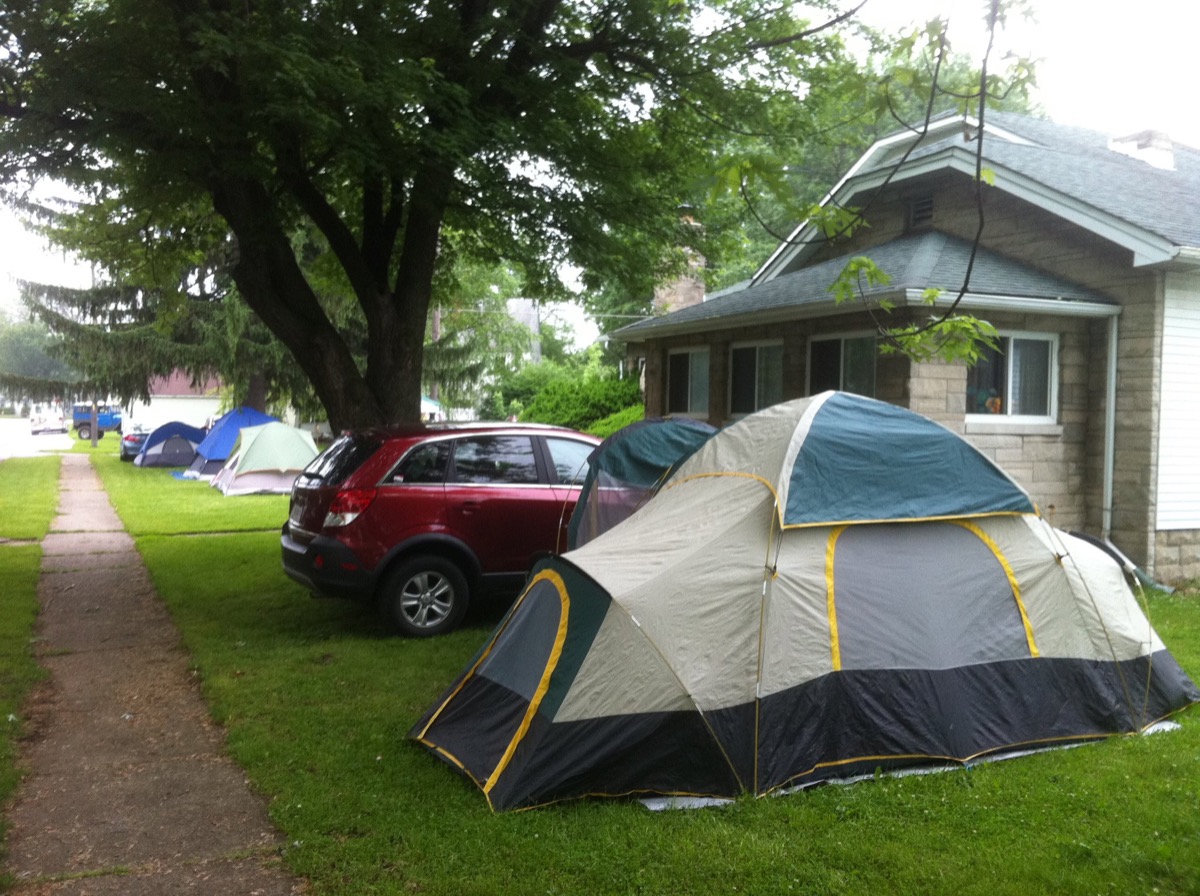
The Coke Lot and the official IMS camping options are not hotels in any traditional sense. They are large parking-lot encampments that fill with RVs and tents in the days before the race. The Coke Lot is the most famous of these and is its own thing — a small city of motorsport fans that builds up over the week.
What the Coke Lot gives you: complete immersion. You wake up at the speedway. The race-day morning commute is a walk. The atmosphere is unlike any other accommodation option in motorsport.
What the Coke Lot costs you: comfort. The shared bathrooms are honest. The infrastructure is functional. Sleep is not guaranteed. This is a young person’s option, or a deeply committed fan’s option, or a once-in-a-lifetime adventure option.
This zone is best for: people who specifically want the IMS camping experience as part of their story. Racing Passport coordinates RV rentals and camping pad reservations for the small number of clients who request this each year.
Why the hotel decision matters more than people expect
The Indianapolis 500 weekend is long. Most attendees arrive Thursday or Friday and depart Monday. That is four to five nights. The hotel is the base for everything that happens between sessions, between days, and around the race itself.
A hotel choice that does not match the trip you actually want to take will show up in a hundred small frictions. Long drives at the wrong times. Meals taken in suboptimal places because driving twenty miles for dinner is too much. Groups splitting up because some people want to be at the track and some want to be downtown. Bad sleep because the property was loud or the bed was bad or the AC failed in eighty-five degree humidity.
The hotel decision is also the one with the earliest deadline. Speedway township inventory closes by July of the year before the race. Premium downtown rooms close by January for May. By the time you are ready to book in March of the race year, what is left is what was left after everyone else picked.
How Racing Passport approaches hotel selection
For a 2027 Indianapolis 500 travel package, one of our Indy 500 packages, the hotel decision is the first thing we talk about. The questions are practical: who is in the group, what is the trip rhythm you want, do you need to be downtown for dinners or at the track for early mornings, and what is your tolerance for race-day commute.
Once we know the answers, we select the property. We have relationships with the properties in each zone. We hold inventory under our affiliations with Roadtrips, Ensemble, and our Rainbow Getaways host agency. The room you end up in is the room that fits your trip, not the room that was left over.
Hotels are included in every Racing Passport Indianapolis 500 travel package. We handle the booking, the room block coordination if you are a group, the special requests, and any changes during the trip itself. If something goes wrong with the property, we sort it. That is what handling means.
The booking deadline you actually face
If you are reading this in 2026 thinking about the 2027 Indianapolis 500, you are early. That is a good thing. The best hotels for race week 2027 are taking commitments now. By the time the calendar turns to 2027 itself, the choices narrow fast.
Twelve months before the race is when Racing Passport opens the interest list. Six months before is when most clients want to have committed to a specific hotel zone. Two months before is too late for the premium options.
The Indianapolis 500 happens once a year and there is no makeup race. The hotel decision is the foundation. Build it right and the rest of the weekend follows.
Continue planning: